
Showing posts with label History. Show all posts
Showing posts with label History. Show all posts
Tuesday, September 1, 2015
Ornette Coleman Passes
Jazz legend Ornette Coleman, the visionary saxophonist who pioneered “free jazz” and won a Pulitzer Prize in 2007, has died. Read more


Wednesday, July 23, 2014
Greek Music Reconstruction

http://www.bbc.co.uk/news/business-24611454
The Classical Greeks wrote the earliest expositions on the science of sound, which I never miss an opportunity to expound on to my students or chance passers by. :) As best as I can, despite my sparse knowledge of this science, I explain why some notes sound great together while others are difficult on the ears, like an out of tune instrument (voice!). The reality of consonance (stable) and dissonance (unstable) in sounds comes out of the way our world is, how it was designed, I believe. It is elemental to understanding music composition and forms the basis of our theories about music and the emotions it conveys.
Saturday, December 21, 2013
Handel's Messiah: Historical Background
All these years, I never learned the story! A friend sent me this:
GEORGE FREDERICK HANDEL: MESSIAH'S PREMIERE FREED 142 MEN FROM DEBTOR'S PRISON
“In
1737 Handel’s opera company went bankrupt, and he suffered what seems
to be a mild stroke...Once the composer for royalty, he was now threaten
with debtor’s prison. Deeply depressed, Handel was visited by his
friend Charles Jennens. The wealthy, devout Anglican had written a
libretto about the life of Christ and the work of redemption, with the
text completely taken from the Bible. A fussy perfectionist, Jennens had
written it to challenge the deists who denied the divinity of Jesus.
Would
Handel compose the music for it? he asked. Handel answered that he
would and estimated completion in a year. Soon thereafter, a group of
Dublin charities approached Handel to compose a work for a benefit
performance. The money raised would help free men from debtor’s
prison...Now with a text and a motivation, Handel began composing Messiah on
August 22, 1741. Within six days, Part One was finished. In nine more,
Part Two. Six more and Part Three was done. It took him only an
additional two days to finish the orchestration...He rarely left his
room and rarely touched his meals. But in 24 days he had composed 260
pages...
When
he finished writing what would become known as the Hallelujah Chorus,
he said “I did think I did see all Heaven before me, and the great God
himself.” ...The premiere on April 13, 1742 at Fishamble Street Musick
Hall was a sensation. An overcapacity crowd of 700 people attended,
raising 400 pounds to release 142 men from prison.”
George Frederick Handel (1685-1759) as recounted in 131 Christians Everyone Should Know (Nashville: Christianity Today, 2000), p. 113-114.
Last night, Jenni and I attended Handel’s Messiah in downtown Denver. It was performed by the Colorado Bach Ensemble and
directed by James Kim. It is likely that we will look back on the
Christmas season 2014 and say this was the most sacred and precious
memory for few experiences exalt Scripture’s Messiah with such
magnificence.
Of
course we just love that Handel performed this oratorio not for
personal gain for the purpose of setting people free from financial
slavery. Though originally performed at Easter, it has also become a
Christmas tradition because the three movements proclaim the prophecies,
the passion, and the promise of Messiah, our the Lord Jesus Christ.
If
you live anywhere near Boulder or Fort Collins, CO, we urge you to
attend one of their final two performances on December 21 or 22, 2013.
Should this be too far to travel, for about the price of a ticket, we
commend to you our personal favorite three CD set: John Eliot Gardiner,
English Baroque Soloists, Philips 1982. Check it out on Amazon.
Generosity Monk | 11318 West Ontario Ave, Littleton, CO 80127 | 303.888.6052 | gary.
Friday, December 13, 2013
Article: Let’s Rethink Our Holly-Jolly Christmas Songs
 Let’s Rethink Our Holly-Jolly Christmas Songs - Russell Moore
...We ought to make sure that what we sing measures up with the, as this fellow would put it, “narrative tension” of the Christmas story.
The first Christmas carol, after all, was a war hymn. Mary of Nazareth sings of God’s defeat of his enemies, about how in Christ he had demonstrated his power and “has brought down the mighty from their thrones and exalted those of humble estate” (Lk. 1:52). There are some villains in mind there.
Simeon’s song, likewise, speaks of the “fall and rising of many in Israel” and of a sword that would pierce the heart of Mary herself. Even the “light of the Gentiles” he speaks about is in the context of warfare. After all, the light, the Bible tells us, overcomes the darkness (Jn. 1:5), and frees us from the grip of the devil (2 Cor. 4).
In a time of obvious tragedy, the unbearable lightness of Christmas seems absurd to the watching world. But, even in the best of times, we all know that we live in a groaning universe, a world of divorce courts and cancer cells and concentration camps. Just as we sing with joy about the coming of the Promised One, we ought also to sing with groaning that he is not back yet (Rom. 8:23), sometimes with groanings too deep for lyrics...
Read More: Let’s Rethink Our Holly-Jolly Christmas Songs
Monday, November 11, 2013
Art Philosophy & Criticism ( and a New Album)
 I loved reading Gregory Wilbur's thoughts on the arts. While non-Christians may find Biblical teaching irrelevant, aesthetics are still an obvious and worthy study.
CREDO
I believe that beauty is an attribute of God and is therefore a theological issue.
I believe that beauty and excellence are objective and that the Bible provides the standard for what is beautiful and excellent.
I believe... Read more.
Friday, August 23, 2013
Claude Debussy gets honoured with Google Doodle
Yesterday, Google honored Claude Debussy with Google Doodle....To mark 151st anniversary of French composer's birth, an animation is set to Clair de lune, one of his best-known pieces...

Wednesday, November 23, 2011
Happy Thanksgiving!... Songs

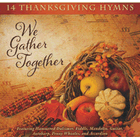 I've been assigning Thanksgiving hymns to my students.
 And Thanksgiving would not be complete without good ol' Charlie Brown! One of my students just began learning this theme. Should be a fun challenge for rhythm and agility.

Thursday, January 27, 2011
*¤*.¸¸.·´¨`»FIRST BLOG ENTRY!!.·°·.»♫
For about a month, I've been ready to start this blog. But writing the first ever post... that was daunting. What finally made me pick today to do it? Well...
ON THIS DAY IN HISTORY:
was born Mozart.
 While he is probably among the top five most well known musicians and composers in Western Civilization, few people have heard of his whole name given to him on January 27th, 1756: Johannes Chrysostomus Wolfgangus Theophilus Mozart. Johannes I understand, because everybody was named Johann, right? :) The Italianized-version of Theophilus later replaced Amadeus (meaning "lover of God"), which was a marketing trick back in the 1700's world of music. However, Chrysostomus, I was intrigued to discover, was chosen for this future master-musician because January 27th is the feast day of Saint John Chrysostom, the "Golden-tongued," in which people celebrate the life and accomplishments this "golden-tongued" pastor of the 4th century. Mozart would certainly become a master communicator as well, though in a different way.
"It is a great consolation for me to remember that the Lord, to whom I had drawn near in humble and child-like faith, has suffered and died for me, and that He will look on me in love and compassion."

"Ubi caritas gaudet, ibi est festivitas."
"Where love rejoices, there is festivity."
 ♫*¤*.¸¸.·´¨`
ON THIS DAY IN HISTORY:
was born Mozart.
 While he is probably among the top five most well known musicians and composers in Western Civilization, few people have heard of his whole name given to him on January 27th, 1756: Johannes Chrysostomus Wolfgangus Theophilus Mozart. Johannes I understand, because everybody was named Johann, right? :) The Italianized-version of Theophilus later replaced Amadeus (meaning "lover of God"), which was a marketing trick back in the 1700's world of music. However, Chrysostomus, I was intrigued to discover, was chosen for this future master-musician because January 27th is the feast day of Saint John Chrysostom, the "Golden-tongued," in which people celebrate the life and accomplishments this "golden-tongued" pastor of the 4th century. Mozart would certainly become a master communicator as well, though in a different way.
How about a little Mozart then? This is my latest favorite of his choral works: Ave Verum Corpus K.618.
So, now, why this blog? Well, my descriptive blurb at the side will tell you my purpose and focus: to join a larger musical community online, provide resources, and motivate me to continue honing my musical skills and knowledge, especially as they relate to piano, for the glory of God, a goal which many of my favorite musicians strove for.
"It is a great consolation for me to remember that the Lord, to whom I had drawn near in humble and child-like faith, has suffered and died for me, and that He will look on me in love and compassion."

"Ubi caritas gaudet, ibi est festivitas."
"Where love rejoices, there is festivity."
John Chrysostom
♫*¤*.¸¸.·´¨`
Subscribe to:
Posts (Atom)